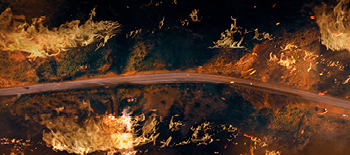
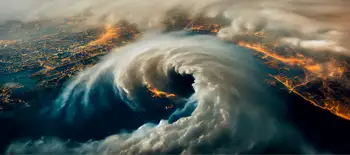
It’s nearly impossible to keep up with the news without seeing images of the devastation caused by wildfires in the United States and Canada. Millions of us have been affected by wildfires, whether we’ve experienced loss, seen flames in the distance, or breathed air from fires hundreds, even thousands, of miles away. In 2024, a total of 61,685 reported wildfires burned in the U.S., totaling approximately 8.85 million acres. During the same period in Canada, more than 13 million acres burned. Clearly, the threat of wildfires is growing. According to the Joint Economic Committee of the United States Congress, the total cost of wildfires in the U.S. ranges from $394 billion to $893 billion annually.
Architects, landscape architects, engineers, and other design professionals involved in master planning projects must be aware of this constant threat. Planning can’t prevent all damage, but can help residential or industrial developments minimize the loss of life and property.
To learn more about how master planning can play a key role in wildfire prevention and mitigation, I spoke with Andrew Foote, AXA XL Senior Risk Consultant. Andrew has spent the past seven years gaining an understanding of our insureds’ wildfire exposures and what they can do to reduce them. Our conversation follows:
Brett Stewart: What’s the first step toward reducing a planned development’s wildfire exposure?
Andrew Foote: Master planning begins with site selection, which should be based on an understanding of the site’s current wildfire risk exposure. Whether a design professional is trying to help a client select a site or the site is already determined, they need to find out what the wildfire exposure is (along with the exposure for floods, earthquakes, and more, of course). Wildfire exposures have three components: fuel, topography, and weather. There are many sources for obtaining insights into this information, including the U.S. Geological Survey and the Canadian Wildland Fire Information System.
Let’s say a client wants to build a resort near the top of a mountain. While that setting might be beautiful and appealing for a hotel property, wildfire dynamics generally promote uphill spread faster than downhill. One can still build there, but the design team must consider the contribution of slope to the wildfire hazard, which exists now and will in the future. This is also a critical consideration when creating evacuation or defense plans to use once the property is occupied.
There are many sources for wildfire hazard maps, almost all of which are based on the presence of vegetative fuels. Federal, state, and local agencies may all have products available that cover the region under consideration. One thing often missing on maps, however, is a line demarcating the area’s Wildland-Urban Interface, or WUI. The term describes the places where our built environments interact and mix with nature’s designs. When wildfires burn near and through these areas, our built environments serve as potential fuel that may propagate the flames into areas where the vegetation hazard would otherwise be considered minimal. When this happens, it’s often referred to as ‘conflagration,’ meaning that the structures have become the primary fuel path for the fire’s spread.
Another factor to consider is follow-on perils or, as I call them, ‘wildfire aftershocks.’ When a wildfire burns, it doesn’t just affect the standing vegetation. Intense heat leads to a nearly complete drying of the soils, which leads to less stability for slopes. Vegetation with shallow root structures is also lost in the flames, and rainfall may cause severe erosion. In extreme cases, the soils will become hydrophobic, meaning that their ability to absorb and hold water is greatly reduced. This leads to more water running downslope faster, exacerbating flooding and causing even more erosion. That’s what we’ve seen in fires on hillsides in Malibu, California, for example.
BS: How important are means of ingress and egress to a master plan, in terms of wildfires?
AF: Planning multiple means of ingress and egress is critical. One of the key contributing factors in the tragic Camp Fire in Paradise, California, in 2018, was that there were only two roads in and out of the town, and the fire blocked both. It’s easy to armchair quarterback these events, but we owe it to ourselves and future generations to learn and apply the hard lessons we’re living through.
BS: Once a site has been selected, what are some of the important design factors that might help prevent a wildfire or slow its spread?
AF: A big reason why wildfires are worse, or at least larger, today is the increased accumulation of fuels on our landscapes. However, not all trees or vegetation react the same way when exposed to fire. Juniper trees, for example, have high oil content, which contributes to both a lower ignition energy requirement and an increased heat release compared with other vegetation with higher water content.
Vegetation selection is part of what I consider ‘passive protection,’ meaning protection that’s always ready and needs no action for a successful outcome. What does that look like? No combustible vegetation within five feet of a structure. When creating a master plan, be sure that hazard trees are removed. A hazard tree is something that could land on or next to a structure, completing the chain of combustible material from the outskirts of a defensible space zone right up to the building. If the tree were to fall, it would compromise the noncombustible space the owner has worked to achieve. If there is a 30-foot-tall tree, for example, it should be at least 35 feet from any structure. Ground slope also plays a role when determining the necessary radius for defensible space around a site. Vegetation on steep slopes may be more difficult for manual response to reach and should be cut further back from the building.
As long as exterior cladding is noncombustible and rated to withstand a wildfire hazard, the structures are in a strong position to survive. However, one reason wildfires cause so much damage is that windblown embers make their way inside structures...
BS: Can you discuss the importance of building materials selection?
AF: Materials selection is another critical part of master planning and the most effective form of passive protection. As long as exterior cladding is noncombustible and rated to withstand a wildfire hazard, the structures are in a strong position to survive. However, one reason wildfires cause so much damage is that windblown embers make their way inside structures, often through vents leading into attics or crawl spaces. These spaces are naturally ventilated and meant to breathe, but they can ingest sparks and flying embers. These can, in turn, ignite combustible material within, such as wooden building members, sawdust left over from construction, and insect or bird nests. The list is nearly endless, but the result is a fire that burns a structure from the inside out. These fires are incredibly difficult for manual response to reach and control. Purpose-designed vents are available that will exclude embers from these spaces and prevent such ignitions.
BS: What we used to consider ‘once-in-a-hundred-years’ types of catastrophes seem to occur more frequently. How does this increase factor into master planning?
AF: Every planner needs to fully envision what a worst-case scenario would mean for their location. Whether it was the tragedy in Paradise or in Jasper, Alberta, a common refrain is, ‘We never thought it could be this bad.’ Well, we need to start thinking about how bad it really could be and then planning and building accordingly. To your point about once-in-a-hundred-years events, our ability to predict the reoccurrence of wildfires on our landscapes is not as refined as the methodology applied to predicting the reoccurrence of floods or earthquakes. Weather, one of the exposure factors I mentioned earlier, plays a major role in both vegetative regrowth and the wet/dry cycles that influence a region’s wildfire hazard. We are getting better, but still have a long way to go in predicting where wildfires will occur 6 – 12 months into the future.
BS: If you had to leave us with one example that drives home your advice about master planning for worst-case scenarios, what would it be?
AF: One story immediately comes to mind, that of a medical campus in California. I won’t go into too much detail about the where and when, but this remains one of the largest single-site losses I’ve dealt with. Picture this—brick-faced buildings surrounded by manicured lawns, trees neatly trimmed, landscaping well-watered, and lush, treed areas kept back 200-plus feet. It was supposed to be immune from wildfire. But there was a vector that hadn’t been considered. Every building had an attic, and those attics had vents. The day the fire burned, measured wind speeds in that town were the highest on record. Windblown embers crossed the defensible space around the buildings, entered the vents, and the result was an overall loss of $400 million plus. If that doesn’t indicate how vital it is to imagine a worst-case scenario and recognize how hidden vulnerabilities lead to losses, I don’t know what will. I’ll leave you with this—where wildfires are concerned, damage is preventable, master planning is essential.
A note to property owners and those who design for them: AXA XL Risk Consulting is available to deepen your understanding of how wildfire can impact your facility. Our unparalleled knowledge of commercial properties provides us with unique insights into the risk that wildfire poses to your project or business. Thorough analyses of vegetative fuel pathways and structural vulnerabilities inform recommendations customized for your operations to prevent damage and downtime. Those recommendations, along with collaboration between our engineers and your site personnel to vet pre-incident response planning and training, help ensure the best outcome possible.