Mass timber is transforming how we build. It’s not just about using engineered wood; it’s about a whole approach that blends sustainability, efficiency, and design appeal. But as with any evolving construction method, mass timber brings its own set of risks. The good news is that by understanding and planning for those risks—especially fire and water—teams can unlock the full potential of mass timber projects.
What is Mass Timber, anyway?
Think of a mass timber project as one that uses large dimension engineered wood products for the structure. That can include Cross Laminated Timber (CLT), Nail Laminated Timber (NLT), Dowel Laminated Timber (DLT), Glue Laminated Timber (GLT), and other evolving types. Many projects also mix mass timber with concrete or steel in hybrid systems. The core idea is to take regular lumber and form it into big, layered members that deliver strength, stability, and predictability, enabling structures that can rise much higher than traditional light-frame wood. These products are strong, stable, and increasingly capable as structural systems in buildings—well beyond what people typically associate with wood.
The mass timber market is on a growth trajectory. As of June 2025, there were 1,217 mass timber projects in design and 1,307 construction or already built, totaling 2,524 active projects. That’s a big jump from roughly 500 projects in 2020 and about 1,000 in 2023. Industry chatter suggests there could be as many as 24,000 mass timber buildings by 2034. A snapshot of the market’s economics shows the global mass timber construction market topping $857 million in 2021 with forecasts estimating it could reach $1.5 billion by 2031.
With growth comes new challenges
Builders and their insurers are learning together how to reduce risk so the benefits—speed, aesthetics, lighter loads, and potential carbon savings—are fully realized.
Why is mass timber usage increasing? There are a few big reasons why developers and designers are turning to mass timber more often:
- Emissions footprint: Building with cement and steel is energy-intensive and hard to decarbonize. Mass timber can lower emissions associated with materials—estimates range from about 13% to as much as 26.5% reduction. And wood is renewable.
- Construction advantages: Mass timber can speed up schedules, reduce labor needs, and be lighter, which means lighter foundations in some cases.
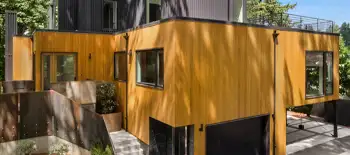
- Finishes and aesthetics: Mass timber can serve as both structure and interior finish. Exposed timber creates a warm, natural, modern look that many occupants find appealing.
- Biophilia and occupancy: The natural, human-friendly vibe of timber interiors can boost occupant satisfaction and even marketability.
But the flip side is that as the market grows, questions about risk, reliability, and cost of rehabilitation rise too. That’s where careful planning and collaboration come in. There’s a core thread across all mass timber products. They share certain risks and building concerns that have consistently shown up in insurance claims -- fire and water. So, builders and insurers are looking closely at these risks to see how they can plan more effectively.
Fighting fire and water damage
Fire resistance in mass timber can be robust, and many projects do well with strong fire management practices. Yet construction is a period of particular vulnerability. Fire protection systems may not be fully installed or operational, and there can be gaps in compartmentalization and ongoing fire safety discipline.
A recent high-profile case highlighted how critical it is to enforce fire protection measures during construction. In Paris, a July 2025 fire on an exposed mass timber project drew attention to vulnerabilities when protection measures aren’t fully in place. The likely culprits included unprotected structural elements and facade panels, high-fire-load potential from site equipment, and a need for more rigorous, system-level fire safety protocols during construction. The exact cause wasn’t confirmed, but the takeaway is clear: construction-phase protection matters.
Water-related losses, often from rainfall or moisture intrusion, have been a major driver of losses. Water can do as much or more damage as fire if not managed properly, especially when timber elements are exposed to the elements during construction or delayed enclosure.
There are practical, easy-to-implement protocols that can help reduce both fire and water risks on mass timber projects. Examples include appointing a dedicated fire safety lead, using hot works and wet works permits, quickly enclosing and sealing joints, and employing moisture monitoring technologies along with weather monitoring and moisture management practices. Ongoing training, clear emergency procedures, and a rigorous QA/QC program help maintain protective measures over time and keep risks in check.
There’s a core thread across all mass timber products. They share certain risks and building concerns that have consistently shown up in insurance claims -- fire and water. So, builders and insurers are looking closely at these risks to see how they can plan more effectively.
Collaboration to boost understanding
Insurers aren’t sitting on the sidelines. They’re actively trying to understand mass timber performance, repairability, and the economics of rehabilitation after incidents. One practical example is the Mass Timber Insurance Action Plan (MTIAP). This initiative brings together the Climate Smart Buildings Alliance, the Canadian Wood Council, insurers, builders, and other players to tackle root causes that can affect insurance rates and adoption.
MTIAP began in 2024 with a broad consultation network with more than 25 insurance organizations, including AXA XL, and 30+ timber/building groups. Funded by Natural Resources Canada’s Green Construction Through Wood program, it has laid out four pilots to address persistent challenges:
- Limited data volume: There aren’t many mass timber insurance claims yet, which makes risk modeling tricky. A data trust pilot is exploring secure data sharing so insurers and contractors can learn from real incidents and better understand risk and restoration needs.
- Limited relevant research: Most research has focused on regulatory questions rather than insurer concerns like full restoration costs after water or fire damage. This pilot identifies the most important questions and lays out design principles to guide researchers.
- Contractor verification: Mass timber projects require specialized skills, and insurers lack a standard method to assess a contractor’s expertise. A pilot with a subcontractor prequalification platform is developing a scoring system that factors in mass timber experience, helping insurers gauge risk more accurately.
- Insurance capacity: Large mass timber projects often require multi-party capacity because individual insurers can’t cover everything. This pilot looked at market- and policy-level solutions, including the potential for a government- or industry-backed captive to help reduce development costs and expand capacity.
An additional point of attention is the supply chain and origin of wood. The increase of use of wood in construction should not lead to an increase of deforestation. One of the underwriter’s task, with help of clients is, to check on the origin of the wood supplied which should be sustainable and suppliers should take care trees are re-planted avoiding deforestation.
Phase one of MTIAP is due to wrap up at the end of 2025, with a final report. There’s talk of a second phase that could include a Mass Timber Insurance Test Facility. The idea would be to run live tests that simulate in-situ fire and moisture events to validate repairs and rehabilitation approaches beyond lab results. FPInnovations is leading this effort, coordinating a cross-industry panel of insurers, builders, designers, brokers, and government entities. The objective? Remove roadblocks, better understand expected rehabilitation costs, and reduce financial uncertainty for insurers. There’s also a safety upside: scenario-based testing can help fire services fine-tune their own risk assessments.
A collaborative path forward
The momentum behind mass timber is undeniable. Its benefits, including lower embodied carbon, faster construction, and strong aesthetic and health appeal, are real. The flip side is clear: successful mass timber adoption hinges on disciplined risk management and collaborative problem-solving across the entire ecosystem -- architects, engineers, builders, owners, insurers, and researchers.
Mass timber is not a speculative trend; it’s increasingly a standard option in many markets. With careful planning, rigorous risk management, and strong collaboration, the full benefits—environmental, economic, and design-oriented—can be realized while keeping people, property, and investments safe.