When the 2026 FIFA Men’s World Cup soccer tournament kicks off in North America later this month, it’s expected to become the most widely watched sporting event in history.
FIFA, the sport’s governing body, expects more than five million fans to attend matches across Canada, Mexico and the United States, with about six billion viewers slated to tune in to watch the games on TV.
This year’s tournament will mark the first time in the event’s almost 100-year history that
three countries have held games. The 2026 edition will also see an increase in the number of teams taking part with 48 national sides competing for soccer’s biggest prize.
Sixteen cities straddling southeastern and southwestern Canada, the central, western and eastern United States and inland Mexico will hold matches, while training facilities and team base camps are scattered across the three host nations.
The diversity of locations creates numerous logistical challenges for tournament organizers. And it increases the potential for disruption caused by acute extreme natural hazards like hurricanes, wildfires, hailstorms, tornadoes and flooding, as well as high air temperatures and humidity. The risks vary regionally, with some stadium locations at greater risk of certain natural hazards.
Extreme heat poses risk to health
Extreme heat and humidity have been identified as challenges at all locations for the 2026 tournament. This risk is exacerbated by the ongoing and worsening El Niño – a sustained period of warmer-than-usual temperatures in the Equatorial Pacific Ocean. This can act as Earth's oceanic ‘radiator’, capable of heating or cooling the global atmosphere. This year’s El Niño event is forecast to have an extreme magnitude of +2°C, surpassing the magnitude of many past El Niño events. This will influence global weather, and heighten the likelihood of certain extreme weather events including drought, wildfires, thunderstorms and flooding.
The US Government’s Climate Prediction Center said last month that there was an 82% chance of El Niño emerging between May and July, with a 96% chance in December 2026-February 2027. Several meteorological agencies have said this year’s event, which is impacted by a marine heatwave that has been taking place in the North Pacific since last year, could intensify to become what is colloquially known as a “Super” or “Godzilla” El Niño; which would likely make 2026 one of the hottest years on record.
Extreme heat and humidity pose risks to the health of both players and spectators at World Cup games. FIFA has introduced mandatory three-minute cooling breaks in each half of every match of the tournament. And many of the match starts have been scheduled for local evening times to avoid the hottest parts of the day. The availability of water for spectators at matches will be key too.
Thunderstorm hazards
Football for Future, a UK-based group of climate and sustainability experts, recently produced a global climate risk report for soccer.
According to the ‘Pitches in Peril’ report, 14 of the 16 U.S. stadiums where FIFA’s World Club Cup competition was played in June last year, exceeded safe-play thresholds for at least three major climate hazards, including extreme heat, unplayable rainfall and flooding.
Several games during the tournament were disrupted by heat and thunderstorms, including the match between Boca Juniors and Auckland City in Tennessee, which was suspended for 50 minutes because of lightning.
FIFA enforces a strict 30/30 lightning rule across all professional soccer tournaments and grassroots games. The rule dictates that if lightning is spotted, or if the gap between a lighting flash and hearing thunder is less than 30 seconds, all match personnel and players must seek shelter immediately. The game cannot restart until 30 continuous minutes after the last lightning flash or thunderclap. In early June, a pre-tournament warm-up match between Saudi Arabia and Puerto Rico was stopped for almost two hours after a series of lightning flashes.
US Midwest and East Coast locations are particularly vulnerable to thunderstorms, which, in addition to the risk of lightning strike, can lead to extreme tornadoes, hail and wind.
The most active thunderstorm season runs from March until August, raising the significant possibility that some World Cup matches may need to be delayed or postponed.
Hurricanes possible
Although the World Cup is scheduled to take place outside of the most active hurricane months of August and early September, it is not unusual to have extreme hurricanes making landfall in North America in June or July.
Indeed, on July 8, 2024, Hurricane Beryl made landfall in Texas as a Category 1 hurricane and traveled to within 50 miles of the NRG Stadium in Houston.
Houston will host seven games in this year’s World Cup, including one of the knock-out ‘Round of 16’ matches.
If a similar event to Hurricane Beryl were to occur again this year at a similar time of year, it would cause significant travel disruption just around the date of the final scheduled match at the NRG Stadium, potentially leading to knock-on delays to the quarter- and semi-finals the following week.
The US East and Central coastal States are the most prone to hurricanes of the venues for the tournament, with an average of three landfalls every two years.
Wildfires could affect air quality
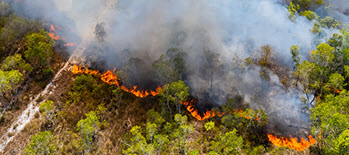
The 2026 wildfire season has begun – earlier than usual – and an above-average number of fires have already been reported.
The Western US and Canada are particularly susceptible to wildfire risk as illustrated by the devastating Los Angeles-area fires of January 2025.
While most stadiums have significant protection from wildfire, the effect of smoke emissions on air quality could pose a risk, particularly since smoke can travel huge distances.
In 2023, for instance, Canada’s most destructive-ever wildfires caused a significant spike in air pollution across Canada and large swathes of the United States.
In July 2025, the Canadian Football League (CFL) postponed the Saskatchewan Roughriders v. Calgary Stampeders game in Regina due to an extreme Air Quality Health Index (AQHI) rating of more than 10, driven by nearby wildfires. The index measures the risk that air quality may have on human health and sets a threshold for sporting event postponement of 7.
While there is no FIFA threshold for air quality levels at which matches must be paused or postponed, there’s a real likelihood that a decision could be taken to delay games based on real-time conditions and local public health advice.
The 2026 FIFA Men’s World Cup will be the largest ever edition of the world’s most-watched sporting event
Insurance impact?
The 2026 FIFA Men’s World Cup will be the largest ever edition of the world’s most watched sporting event and it’s expected to generate almost $11 billion in revenues.
Delays caused by natural hazards could have numerous financial and economic implications, including extended broadcast windows, disrupted advertising schedules, rising staffing costs, potential fan compensation claims and logistical challenges for teams.
From an insurance perspective, delays could also give rise to contingent business interruption claims, as financial losses linked to delays, postponements or cancellations may be covered under certain insurance policies, depending on specific terms.
With billions of fans eagerly looking forward to watching their national teams and players, hours of proactive risk management have gone into planning the 2026 event.
As the 2026 FIFA Men’s World Cup approaches, it serves as a reminder that even the grandest and globally- celebrated events are not immune to natural hazard risks — highlighting the importance of risk experts, insurers and reinsurers in constantly assessing and communicating these risks to ultimately lead to their mitigation.